1. Discuss history and development of the English language.
2. English Development Project
History of the English Language
A short history of the origins and development of English
The history of the English language really started with the arrival of three Germanic tribes who invaded Britain during the 5th century AD. These tribes, the Angles, the Saxons and the Jutes, crossed the North Sea from what today is Denmark and northern Germany. At that time the inhabitants of Britain spoke a Celtic language. But most of the Celtic speakers were pushed west and north by the invaders - mainly into what is now Wales, Scotland and Ireland. The Angles came from "Englaland" [sic] and their language was called "Englisc" - from which the words "England" and "English" are derived.
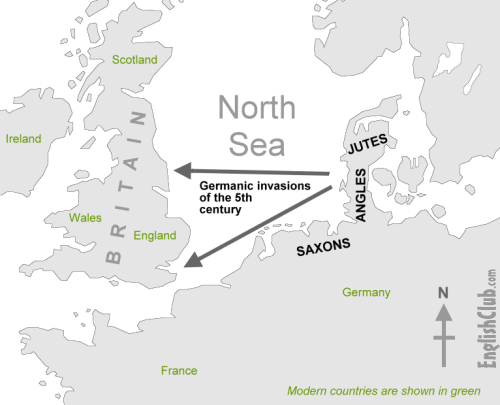 Germanic invaders entered Britain on the east and south coasts in the 5th century
Old English (450-1100 AD)
The invading Germanic tribes spoke similar languages, which in Britain developed into what we now call Old English. Old English did not sound or look like English today. Native English speakers now would have great difficulty understanding Old English. Nevertheless, about half of the most commonly used words in Modern English have Old English roots. The words be, strong andwater, for example, derive from Old English. Old English was spoken until around 1100.
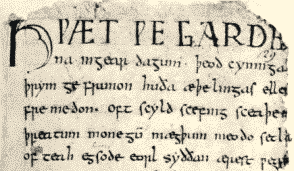 Part of Beowulf, a poem written in Old English
Middle English (1100-1500)
In 1066 William the Conqueror, the Duke of Normandy (part of modern France), invaded and conquered England. The new conquerors (called the Normans) brought with them a kind of French, which became the language of the Royal Court, and the ruling and business classes. For a period there was a kind of linguistic class division, where the lower classes spoke English and the upper classes spoke French. In the 14th century English became dominant in Britain again, but with many French words added. This language is called Middle English. It was the language of the great poet Chaucer (c1340-1400), but it would still be difficult for native English speakers to understand today.
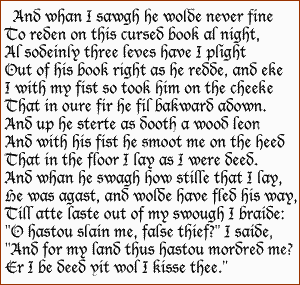 An example of Middle English by Chaucer
Modern English
Early Modern English (1500-1800)
Towards the end of Middle English, a sudden and distinct change in pronunciation (the Great Vowel Shift) started, with vowels being pronounced shorter and shorter. From the 16th century the British had contact with many peoples from around the world.
This, and the Renaissance of Classical learning, meant that many new words and phrases entered the language. The invention of printing also meant that there was now a common language in print. Books became cheaper and more people learned to read. Printing also brought standardization to English. Spelling and grammar became fixed, and the dialect of London, where most publishing houses were, became the standard. In 1604 the first English dictionary was published.
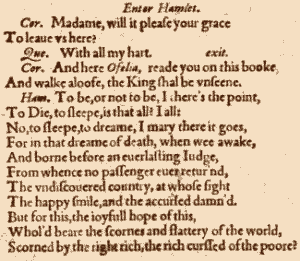 Hamlet's famous "To be, or not to be" lines, written in Early Modern English by Shakespeare
Late Modern English (1800-Present)
The main difference between Early Modern English and Late Modern English is vocabulary. Late Modern English has many more words, arising from two principal factors: firstly, the Industrial Revolution and technology created a need for new words; secondly, the British Empire at its height covered one quarter of the earth's surface, and the English language adopted foreign words from many countries.
Varieties of English
From around 1600, the English colonization of North America resulted in the creation of a distinct American variety of English. Some English pronunciations and words "froze" when they reached America. In some ways, American English is more like the English of Shakespeare than modern British English is. Some expressions that the British call "Americanisms" are in fact original British expressions that were preserved in the colonies while lost for a time in Britain (for example trash for rubbish, loan as a verb instead of lend, and fall for autumn; another example, frame-up, was re-imported into Britain through Hollywood gangster movies). Spanish also had an influence on American English (and subsequently British English), with words like canyon, ranch,stampede and vigilante being examples of Spanish words that entered English through the settlement of the American West. French words (through Louisiana) and West African words (through the slave trade) also influenced American English (and so, to an extent, British English).
Today, American English is particularly influential, due to the USA's dominance of cinema, television, popular music, trade and technology (including the Internet). But there are many other varieties of English around the world, including for example Australian English, New Zealand English, Canadian English, South African English, Indian English and Caribbean English.
The Germanic Family of Languages
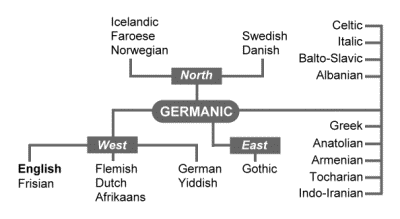 English is a member of the Germanic family of languages. Germanic is a branch of the Indo-European language family.
| A brief chronology of English |
|---|
| 55 BC | Roman invasion of Britain by Julius Caesar | Local
inhabitants
speak
Celtish |
| AD 43 | Roman invasion and occupation. Beginning of Roman rule of Britain |
| 436 | Roman withdrawal from Britain complete |
| 449 | Settlement of Britain by Germanic invaders begins |
| 450-480 | Earliest known Old English inscriptions | Old
English |
| 1066 | William the Conqueror, Duke of Normandy, invades and conquers England |
| c1150 | Earliest surviving manuscripts in Middle English | Middle
English |
| 1348 | English replaces Latin as the language of instruction in most schools |
| 1362 | English replaces French as the language of law. English is used in Parliament for the first time |
| c1388 | Chaucer starts writing The Canterbury Tales |
| c1400 | The Great Vowel Shift begins |
| 1476 | William Caxton establishes the first English printing press | Early
Modern
English |
| 1564 | Shakespeare is born |
| 1604 | Table Alphabeticall, the first English dictionary, is published |
| 1607 | The first permanent English settlement in the New World (Jamestown) is established |
| 1616 | Shakespeare dies |
| 1623 | Shakespeare's First Folio is published |
| 1702 | The first daily English-language newspaper, The Daily Courant, is published in London |
| 1755 | Samuel Johnson publishes his English dictionary |
| 1776 | Thomas Jefferson writes the American Declaration of Independence |
| 1782 | Britain abandons its colonies in what is later to become the USA |
| 1828 | Webster publishes his American English dictionary | Late
Modern
English |
| 1922 | The British Broadcasting Corporation is founded |
| 1928 | The Oxford English Dictionary is published |
"History of the English Language," English Club.
English Development Project
- Pair up.
- Prepare a presentation for the class about some aspect of the development of the English language. (It could be broad or specific.)
- Examples:
- a map showing locations of different cultures that influenced the language
- the aftermath of the Norman Invasion and/or the Battle of Hastings
- differences in Old English, Middle English, and Modern English
- You may use whatever format you would like.
- Your presentation must be a minimum of two minutes long.
- Both partners must participate in the presentation in some capacity.
- You will have class time on Wednesday and Thursday to work on this.
- This is due on Monday, August 31.
- If you do a power point, turn it in to the folder labeled English Development Project in Google Classroom.
- This is a test grade.
- Grading guidelines-- You will receive up to 10 points for each of the following:
- on time
- minimum time requirement
- both partners participating
- on topic
- spelling, grammar, punctuation, sentence structure, etc. (if applicable)
- accuracy
- originality
- presentation
- something special
- citations
